Showing posts with label Terrain analysis.. Show all posts

Tuesday, December 2, 2014

Drakkar & Dromon - Oars and War


Dromon and Drakkar, Oars at War.
Gordon S Fowkes, KCTJ

Both Viking ship and Mediterranean Galley played major roles in the Crusade as together they gained a few centuries of naval and maritime superiority until the Ottomans picked up where the Arabs had left.  These war vessels were often modified and expanded for commercial purposes and complemented the rise of the short fat sailing ships that was the life blood of the 12th Century Renaissance. They represented two distinct design and construction plans but which intermingled and married in the shipyards north and south.

--1

Drakkar (Longship) and Dromon (Galley)

The Viking Long Ship was an exceptional sailing ship, with good to excellent rowing capabilities.  It was not long before Viking ships were shortened, the deck in place, and oars were stowed.   The Dromon was the standard Byzantine warship in the Mediterranean which became the warship of choice for all colors and creeds well into the gunpowder age.  Both ships were fast under oars and while it is now accepted that Dromons and other Medieval galleys were rowed with the oarsmen standing up.  Since the Vikings and Byzantines fought with and against each other including service on Dromons against Byzantium’s enemies, it is more than likely that rowing tips and ship design intermingled.

These ships had a high length to width ration in excess of seven to one.  Even as high as ten to one.  This high ratio plus the low angle the oars had to have lowered the freeboard to the point that rowing in rough waters was pointless.  The distance between rowing station (tholes, benches, thwarts, oars) on Viking ships was 32 inches, while on the Dromon it was a foot longer.  Therefore there is likely a wide variety of rowing techniques.  The paper Is  intended to muddy the differences.

Crusade Era crews were made up of free men already organized in fraternal, commercial, and military roles.  In fact the use of galley slaves is a rare exception in history and unsatisfactory when used. The collective skill sets required of oarsmen as shown here requires drill team precision and football ardor


-2

The Boat Races

1959, I was a coxswain on the University of California (Berkeley) Crew, then consisting of the 8-oared shell.  That’s the little guy at the back (aft) of the boat with a big mouth with eight really big guys on the oars.  We used to race up and down the Alameda estuary for races and practice. 

In order to see what these ships and crews were capable of, one can look at You Tube:
“Holy Smokes, they are flying!”  An eight oared shell


-3

Modern racing shells (solo to eight oars) use seats that slide, and so far as we know today, rowing seats had to wait the 19th Century.  More than likely.

Imagine one of those dromons with as many as a hundred oarsmen would look like in a final drive to close with the enemy.

BALANCE OF POWER

The “balance of power” of the oarsmen exerted between port and starboard, and between fore and aft is critical or the ship will heel and wobble. 

Angles of Oars to Water.

4

In order to get maximum power between the oar and the water, the angle must be very low.   This was a major design feature of all galleys and Viking ships which also produced a very low distance between gunnel and water.  This made sailing any long and low ship in troubled waters short and wet. As a consequence oar powered vessels avoided rough water, hugged the shoreline and came on shore for bad weather and/or night.


5


The Galleys of the Mediterranean (later large galleys were used in the Wool trade to reach northern waters were built frame first.  They, like the Romans and Greeks before, drove through the waver rather than over. Unlike them, the ram had been removed and replaced with a prow.  The tactics changed from ramming to boarding.


6

 The Viking Long Ship was clinker built (hull built before framing), and had good sea keeping capabilities as it could bent and twist in rough seas.  Since the water far at sea was likely to have higher waves than on rivers, Viking traders and raiders shortened the length to width ratio to under five to one.  This modification together with decking the thwarts and relying on sail is what is depicted in the arts of the time.  They could not have raided across the North Sea to the Bosporus with a ship too long.


7
Therein lies the mystery, which is where were the oarsman’s hands, feet and fanny relative to the gunnel, oar, thwart and thole (oarlock).  The purpose of this article is to let in more dark to confuse certainty.  The short answer is that more serious rowing required standing, not sitting.  But more before that:

Oars vs Rudder

If the power of the port (left) is greater than starboard (right), the ship will turn to the right (starboard).  This requires the helmsman to steer to port (left) which throws the ship off balance, by leaning away from the turn;  the ship rocks to the outside of the turn which further unbalances the ship.  Been there, done that.
The selection and placement of oarsmen and their oars with a mix of the skinny, round, tall and short to keep that balance is essential.  While in modern rowing, the person has to fit in the boat, while that choice was not as popular back then.

8

Recovered oars at the same site often differ in length.  Some plans and pictures of the multi-decked ships show the outboard oarsmen with the shorter oar rowing closer to the hull.   More common are the images of two or more banks of oars, regardless of number of oarsmen per oar, having all blades paddle in the same row of puddles.

9

Most oar ships of the day normally had a flat deck from bow to stern, but not always.   Some ships placed the higher benches and longer oars towards the stern.  In order for the oars to synchronize, the bow oars (men) were shorter with the taller and longer, the higher. It also provided a commanding view of the crew for those on high.  That and the guys closest to the boss are tall by mutual assent.

When I was a private (E-2) short in stature I marched in the rear, and as is the effect of short last, the column marched like an accordion with the short on the run.  When I was a Captain commanding an Engineer Company, the tall came last, and the formation got short.   On the galleys of the day, the short came first, albeit backward.

 Gearing Ratio

The relative length and gearing ratio (balance) between handle, thole (oarlock) and blade affects the amount of leverage the oarsman can exert in pulling the boat across the water.  The ratio of oar inside the ship versus outside, defined by the location of the thole (hole, oarlock) as a fulcrum.   In the Medieval Era, that ration ranged between 1:3 (one third inside) and 1:4 (one quarter inside).   1:3 favors getting underway faster, while 1:4 favors speed once underway.


9

Catch and Release

All oars must enter and leave the water exactly the same time and angle cleanly to retain the balance of power.  Splashing slows the boat and the race is won on the run, not the drive.  In short when the oars are out of the water.   Catching occurs when the oar goes into the water, and the release….

10

The oars today are feathered on the run in order to evade snagging the blade on the water (ripples and waves).  This reduces how much the oarsman has to raise the blade/lower the wrists on the run versus lowering the blade/raising the wrist.  This distance must be changed as the seas get rougher.

In modern racing boats, this is all in the wrists.  No kidding.  The blade is turned by rotating the oars forward for the catch and back for the release.  The latter uses the rush of water to flip the oars out of the waters, in lieu of yanking against the water.

11

The historical evidence supporting this use of the wrists to make a clean catch and release is indicated by this old piece of statuary. 


12

The Run


13
The Perfect Stroke (Boston)


14

15


The race is won on the run not the drive.  A sloppy but powerful crew will be beaten by a precise albeit weaker crew.


16
 The essential difference between modern crew rowing and of the good old days is that today the oarsmen (oarswomen) is the modern sliding seat which allows full extension of the legs.  Since the upper body has about a third as much power as the whole body, the big mystery in scholarly studies of rowing has been to ignore that the legs were used in rowing in order to go faster than the other guys. Be they close ahead or astern.

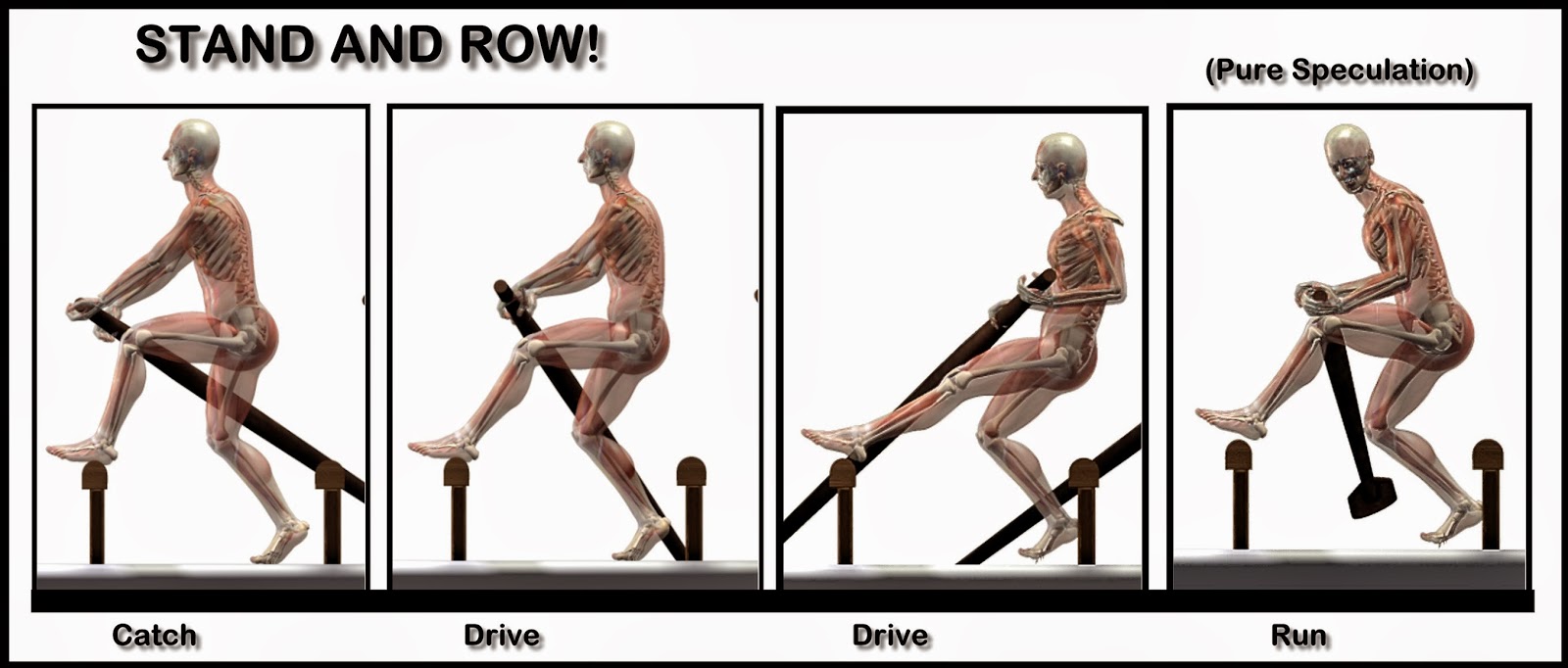
Stand and Row


17
The short answer is that back then they stood and rowed, stepping forward to plant a foot or two against a load bearing member of the ship.  Those include other benches or steps for the purpose. The only time these oarsmen rowed sitting down was in port. This particular example is of a chained oarsman.  At best this shows that standing and rowing was not sitting down.
Later rowing systems based on Italian designs including rowing arrangement of more than one oar to a station, and/or more than one oarsman to an oar.  Crusade Era ships were one and one. 
.


18
These diagrams show illustrate the difference in height relative to rowing stand up or sitting. It is about 3 feet from the deck to the elbows and if sitting.

The basic issue of whether to stand or sit relates to the skeleton and muscular makeup of the body.   The sliding seat likely did not exist, and the amount of stroke an oarsperson sitting down is less than one standing up and moving. Key to this is the difference between seats whether bench or thwart (longitudinally) 

19

 The best ballpark figures I have, show that the distance between thwarts, tholes (oar locks) and oars on Viking ship are about 32 inches (.8 meters) and those on the Galleys were 47 inches (1.2 meters). The oars and tholes in Viking ships were exactly half way between thwarts, with the shield even with the thwart.   


20


21

22
Load Bearing Members Carry the Load of the Members
There is stress wherever the boat, the oar, the water and the oarsman meet and the net result of this stress is a boat in a hurry.  These occur in a sequence from where the foot and the boat, butt and bench, oar and thole, blade and water.  Anything but the strongest materials will cause the boat to stop running.

Leather padding or gaskets reduced the friction of oar on thole.  Some galleys do not have a round thole but a peg or more between which takes up the friction which allowed more than one oar to a thole.   

A standing oarsman on a Viking type ship such as the Knarr could get his weight and body strength stepping on the thwart forward or the smaller one under that thwart.  A galley oarsman normally had a step in front of his bench which was also a load bearing member of the ship.  This is what is shown in the Russian sample.

23

Precision, Decision, and Synchronization.

The subject of oaring boats is huge, with larger variations of equipment and technique.  This treatise shows only show a few combinations.   The drawing in Russian drawing above is one of a ship rowed by slaves (note chain).  The bulk or and primary choice of crews, however, were professional crews of volunteers often chartered by the maritime powers of the world. These ships and oarsmen were often rented out for cash, alliance or privateering.


24


25

Templar light galley- 40 oars, monoreme, crew of 45. Armed with Tension Trebuchet and Greek Fire Projector

Sunday, June 15, 2014

Mind-Body and Battle


MIND-BODY & BATTLE
GSF
In animals as well as man, there is a default choice of courses of action and reaction. But it is a bit more complicated than Fight-Flight-Freeze.   Initially a REVULSION REFLEX inhibits what might be an all-out murderous mutual massacre.  This serves two purposes: maneuver for advantage and the appearance of overwhelming force (INTIMIDATION).   Once one side turns away, the Revulsion Reflex is erased and replaced by the RUN-DOWN REFLEX in which the loser is run down killed, captured, eaten or sold on the slave market.  The end status is submission, even though such results in certain death.

INTIMIDATION
The initial stages of a confrontation include the posturing, growling, snarling and puffing up hair, all of which are signs of aggression. In humans as well.  The controlling factor in intimidation is eyeball to eyeball, or the appearance of it. 
1


 Most animals in nature carry body markings to camouflage the female against discovery during nesting, resting, or child raising.   On the other hand, body markings that make the males competitor appear more ferocious. Some is carried over in human threat displays, Tall hats and capes make the contestant appear larger than life, body markings exaggerate combative appearance.  The male lion has a big mane while the female does not, the mane is the main sex display while other body differences between male and female are not as apparent.  
2

The combat response of the “Freeze” is based on the fact that a moving target attracts the eye, standing still under the right circumstances clouds the predator’s mind (as in Hide).  This is a standard response at night when the enemy lights up the night with searchlights and/or flares.  Hiding in the umbra of taller objects also works

The Peacocks feathers all full of eyes, or the accentuated eyes of Owl or Orca are there to intimidate in this psychological preparation of the battle.  Few animals can face down a pair of human eyes, so I avoid eye contact in sparring and take in the whole person for balance, stance, guard, vulnerable spots and movement.
3
THE BODY AT RISK
Like the tank or aircraft, the human body has vulnerabilities which must be protected.  These include the BRAIN, EYES and VITALS.  That which connects and protects these (MEANS) includes the skeleton, skull, and body operating systems the defense of which life depends: Nervous, Gastro-Intestinal, Respiratory and Vascular. The nervous system includes several subsystems of interest to the warrior.
4

The most common human fighting technique is battery by hand and foot, mostly by hand.  There are only two targets worthy of battery, and that is to affect the Brain and the Lungs.  The skull protecting the brain is a hard target so it must be struck with something soft in order to induce concussion. Conversely, the lungs must be hit with something hard in the guts so as to push the diaphragm upward constricting the lungs.  Plain battery elsewhere is defeated by muscle, bone, and fat.

 5
The skeletal system puts bone to protect the soft parts, and provides a mobile firing platform and weapons system.   The “soft parts” inside the body are protected by the muscles and bone, and are the subsets of the Body regarding Tactical Imperatives.  One versus the other’s.

THE ENGINE (Cardio-Vascular-Lungs).  
Similar to a tank, aircraft, and car engine, the animate require oxygen and fuel to transfer energy to, lubricate, and operate the various components of the body.  In vertebrates this requires lungs to take in air and transfer the oxygen to the blood, which blood picks up nutrients and agents from the various glands and organs.   Together, this constitutes the vitals.

The process of breathing without which life gets short, involves the transfer of oxygen from the lungs into the heart which pumps the oxygen and nutrients throughout the body.   While the rib cage provides considerable protection of damage by blunt instrument, compression of the guts often knocks the breath out of the breather.  Behind and below the guts (intestines), certain vital organs that filter and deliver the chemicals into or out of the blood and digestive systems. These are located in an ellipse with the long axis across the belly from kidney to kidney. 

BELLY SUPERCHARGER
5a

Deep Diaphragm (Belly) Breathing brings in more air in to get more energy out, and relaxes the body (and mind).  Chest breathing is rapid and shallow, and tightens up the body (and mind).  Deep “belly” breathing is the counter to stress.  One must calm down to fight.


THE CENTER LINE
6
This provides two references, the Center Line from nose to groin which is both the center of vulnerabilities, but also the Center Line of the body’s defensive and offensive firepower.  Consequently, a direct face-off between humans place the greatest firepower mutually opposed to the opponents vulnerabilities.   

CENTERS OF BALANCE
7
The terms COG, Center of Gravity ad Center of Mass are often used interchangeably rendering both moot in battle.  It is certain (IMHO) that all nature knows its balance, centers and all.   In this rendition, the center of mass of any creature only moves when the cargo shifts, and the “bone centers” are fixed by the joints which include the shoulders and knees. 

The Center of Gravity is the net result of all the forces influencing the body including the force exerted in standing and running, and includes the forces of any external object that yanks, pulls, or trips the body.

BLOODY HELL

While one bleeds just anywhere, getting to the heart of it is more precise.
8


The command and control of the animate body goes through several nets and systems.

THE NET CENTRIC BODY

The Central Nervous System ties the parts together via several subsystems, some you know, and others operate behind the coded door.  
Chinese Traditional Medicine was unknown to the West and likely the Middle East, but so were the ones we know about today.  Recent work in the martial arts community is making progress In associating the elements of Chinese Traditional Medicine (TCM) with what we know of the body today.  The pressure points of TCM normally are found where a nerve comes to an end, crosses another or divides.  Additional work is being done in affiliating TCM with the Autonomic Nervous System (ANS) according to the Dragon Society (Grand Master Rick Moneymaker, under whom I have studied).

George Dillman Pressure Point Seminar

We usually associate the nervous system with motor and sensory nerves, but well below the conscious level the ANS works in response to the threat as perceived by the Biology of perception which follows two paths into the brain to the switchboard of the Amygdala, Smell and
Audio‐Visual, which produces chemical changes to make things happen or not.  Smell is the oldest of senses and is routed through the Thalamus to activate the Limbic System while Audio‐Visual is routed through the Hypothalamus which goes to the Cortex. Smell (Stink) produces action without reflection.

9The Parasympathetic system appears to be operating in diametric opposition to each other.  The Sympathetic system cranks up under perceived threat, and the Parasympathetic backs off. The Sympathetic reaction, however, is counter-productive to efficient fighting, in particular the heart rate.  Pupil dilation is accompanied by a narrow field of view which does not see or sense attacks coming from the sides. The Oriental system of belly breathing, deep and slow, also slows down the heart rate, increases the field of view, and relaxes the body.  A tense body not only hurts more when hit, the range and speed of the limbs are retarded. 

RELAXATION RESPONSE (Calm down to fight)

This leads to an apparent, but necessary paradigm shift: One must calm down in order to fight efficiently and effectively.  The foaming at the mouth, wild eyed, emotional fighter won’t fight long in the face of deadly calm.   Shouting is targeted and timed to freeze the target at the right time and way.  This calming down effect has many names in the East, but is also found in Western athletics and performance arts.  It is sometimes called the Relaxation Response.  When relaxed, the athlete or artist’s mind becomes detached from the fury of the moment, but operates in a more strategic fashion.  A chattering mind invites battery to the body. 
 
In Close Order Combat at Close Quarters (spear or pike range), one reads of forces who advance with shouts in unison, like “God Wills It” or singing a battle song are also ridding the body of tension, creating a bond within the ranks, and elevates the mind from dwelling too much on what could go wrong. 

THE REVULSION REFLEX

Substantial and credible research has established that the default behavior of humans when faced with the choice of killing don’t kill, don’t shoot, miss deliberately, never forget, and vomit once done.  It is clear that the initial behavior during the initial face to face confrontation is to threaten, posture and maneuver for advantage.   Recent studies of the casualty rates of battles back to antiquity also show abysmally small numbers of casualties or both sides, provided the other side didn’t run.  

10
Since killing is an integral part of life on the planet, there is a question as to why do humans react against killing even when being killed is a clear and present danger.  This reaction is also common to the animal kingdom, few animals launch into an attack without some intimidating (or sneaky) maneuvers.  If the object of their intimidation does not back off, the confrontation can end as both sides back off  This is nature’s way of limiting aggression to issues of dominance (Social Status) or dinner. The lions, gazelles, buffalo, and other wild creatures who are subject of being eaten or beaten only do so when needed.  Otherwise, they share the same space. 
11
Humans don’t settle for that. Usually. 

During WW 2, only 15 to 20% of infantrymen fired their weapons.  The change from paper targets at known ranges to popup silhouette targets at random distances raised the odds in Vietnam to 90-95%. Realistic training, that is the replication of all the sensory inputs normally associated with a given task.  That is why we invented the infiltration course after Korea, to get accustomed to overhead machinegun fire, tracers and all, in a controlled situation. 

12
The routing of sensory inputs by way of the Amygdala, Thalamus and Hypothalamus that is not overloaded with emotions, allows a calmer more trained mind to sort these stimuli and select an appropriate response.  The Trained Mind is where the coded reflexes activating muscle memory and learned responses that can fight on automatic, leaving the relaxed mind to make strategic observations and directions.   This occurs in athletes, dancers, fighter pilots and Friday Rush Hour to function without burning up energy in conscious decision making as that mind is too slow.
http://templarmilitaris.blogspot.com/2014/03/crusade-era-combat-murphys-laws.html

RELAXATION RESPONSE VS REVULSION REFLEX

From a broader point of view, control of the Revulsion Reflex which is primarily driven by the Sympathetic Nervous System (SNS), is to counter with activating the Parasympathetic System in addition to reducing the fear factor of external stimuli, like incoming rounds.  Taking learned responses to cope with the actual physical threats includes digging in, shooting back, wearing protective gear at all times. 

The Knights Templar slept in their combat gear, something that I learned my first week in combat. And they did so without regard to any specific threat assessment.  Unit morale due to the unit replacement system in US forces today has elevated the sense of camaraderie between buddies to a level far above any achieved before or so wide.  Likewise the bonding of the Knights Templar and the other holy orders coupled with a shared set of values, rituals, and combat training worked to override any errant stimuli so they could fight effectively and efficiently. 

TACTICAL AND TECHNICAL PROFICIENCY

The Temple and the Hospital only recruited those who were already MOS qualified (knights, men at arms, sergeants) and bonded together by faith, ritual and hard collective training.  For a unit to function as a unit in combat, they must have trained tougher under simulated combat conditions, and some that aren’t battle.  This includes hunger, exhaustion, confusion, extreme heat and/or cold, rain, snow, and/or dust, all of which are available at Ft Hood Texas often at the same time.

There is little known about the training schedule, program of instruction, of Mission Essential Task List used to train the Order.  The fact that the holy orders and other well trained outfits could assemble on day, or show up in the middle of battle and be able to be deployed effectively means that there had to be a shared and clearly understood way to fight for each of the components and for the leadership.  The Western knights of the 12th Century were far superior to Islamic forces, and particularly at higher levels of command.  Saladin started the reversal of the trend which ended in the 13th Century.  One fatal difference influenced operations was the incessant bickering of the various political components of either side.  

See the Crusade through Arab Eyes, by Amin Maalouf, which shows how screwed up the Muslim side was during the First Crusade until the Third.   During that period of time, Muslim rule passed from Arab to Turk, which did not reverse again until after WW 1. 
LEADING BY EXAMPLE
Crew Served Weapons,

The recent studies of modern combat and firing rates, show that any form of distance between the enemies eyes and our own reduces aversion, and can activate the Run Down and Chase Reflexes. This distancing applies to officers, non-commissioned officers, crew served weapons crews, and those at a distance from the threat.  Knights of the day from Far East to Iceland operated as a crew served weapon, as the knight rarely went unaided or alone.  Except when showing off.
13
Kingdom of Heaven, Kerak. Balien (Right) intercepts Saladin's host (dust in background)
Flags and Bugles.

The noise, dust and confusion of Close Order Battle makes giving verbal orders problematic.  The high notes of the trumpet operate at a frequency that the human ear registers full attention, and bugles are still used (out of respect) today.  Likewise banners, flags, pennons, and Guidons are the default visual means of controlling forces afoot, afloat, or a riding.  The soul that carried the banner of a band of brothers did so without a weapon in hand, and for whom dropping the flag was a major disgrace.  It still is, even though following the flag in current battles would draw fire. 

14
Units lacking the sense of camaraderie and shared experiences have a short shelf life.  Once the enemy turns to run, runs or acts in a panicky way, the Rundown or Chase Reflex automatically reverses the Revulsion Reflex, and the chase Is on.

THE RUNDOWN REFLEX (THE CHASE)
Once the enemy looks away, turns his back, or demonstrates weakness, another equally powerful gut reaction to chase down and kill the enemy without any sense of revulsion.  In battles between forces in close order (side by side, shoulder to shoulder, etc.) turning and running resulted in mass casualties due to aroused avarice by the attacker and suppressed defensive capabilities while running backside to front. 


It is no accident or insidious capitalist warmongering plot that children play “hide and seek”, or running games like “keep away” which goes professional in soccer, football (both), basketball, or hockey.   This behavior like most childhood games is practice for what comes later in life, and is driven by coding in DNA.  Socialization only provides the details.

Some of kids play is not play but training, and it occurs naturally without any external input.
15

More serious “games”
16

Several important factors reduce or counter revulsion reflex include those activities where the mind is occupied with conscious engagement with a complex piece of hardware, like a laser range finder. Or upon rote reaction of certain responses that require the brain to focus on a few important things such as in calling for and adjusting fires like Fire Missions and Tank Gunnery Commands.  Those have to be done right despite foggy brains and fear. 

RESOLUTION:

 This is the part when the loser is massacred on the run even if not edible.  Basketball, Soccer, Rugby, and Hockey (field and ice) are running games with the puck or ball representing the game’s game. This is the part when the family chows down on the defeated, the wounded are bayoneted, and the dead are stripped. In Medieval warfare, the casualties of the side that ran were horrific while in those battle with no panic, or run, American Football is more lethal. 
17  

King Guy of Jerusalem surrenders to Saladin at the Battle at Hattin 1187


18


Sunday, October 6, 2013

THE TEMPLE AND THE TACTICAL IMPERATIVE


The Temple and the Tactical Imperative.
The Shield Wall was an infantry formation unique to Western Medieval forces of the Crusade Era and to the Roman Republican and Imperial infantry.   The shields of the Shield Wall were heavy and large to protect the spearman and the gap between another whose offensive firepower was delivered over the shield.  The primary grip was close to the top and horizontally so that the weight of the shield was carried by the left shoulder by the left arm in a tight “Strong Arm” grip.
 Absorb.  The tactical imperative used in by the defense against the Fist (warhead, blade, blunt end) is to absorb the shock or dissipate it. This also applies to castle walls and fox holes.

The “Strong Arm” grip held close to the shoulder also is reflected on the placement of grips on the shields themselves.  At least one horizontal grip or handle is placed close to the upper edge of the shield and sometimes another horizontal handle across the forearm nearer to the center of the shield depending on size.


The Shield Wall as the name states is a wall that doesn’t or shouldn’t move.   This would risk a gap in the front ranks which is a very bad thing to happen to the infantry.  Once the overlapping shields expose the fighters behind, they become vulnerable.    The English (Anglo-Saxon) shield wall stood on Senlac Hill for twelve hours before the wall was cracked by a Saxon contingent that thought it was Plunder Time and went after some Normans moving to reorganize, reform, and return.  Some say this was a feint, and perhaps it was.


The Bayeux Tapestry shows what happened after


This sort of indiscipline was the death knell of many a battle for whom lost their cohesion. One of the distinguishing tactics of the descendants of the steppe way of war was the bait and switch by fast and flexible forces, usually mounted archers of which more will be told in a following edition.  The bait and switch tempted Crusader knights to do their specialty, the Charge with Couched Lance,  The light horse would evade and withdraw until the Knights cohesion was lost, horses blown, and a gap between them and their infantry. 


The Battle of Liegnitz in 1241 as depicted in the war game link above (8:11 with music) illustrates how the Mongols destroyed a Western Army resulting in the conquest of most of what was Russian at the time. It was not until Ivan the Terrible was the damage undone.


The Tactical Imperatives of that battle give show the Mongols had the right stuff, at the right place and time.  The only Imperatives the West had was the resilience and armor of the mounted knight to parry and absorb Mongol hits.  Over the centuries that followed, the Russians and Poles developed light and middle weight cavalry to be able to evade and return to worry the cohesion of opponents East and West. 

See also maps at of Battle of Mohai Heath:      BATTLE OF MOHI HEATH 1241


To redress imbalances between the heavy mounted knight with power and speed, but not much flexibility and the heavy armored infantry with the ability to absorb but not the speed to evade or duck has been addressed continually down through the ages.   In the Crusade Era, this meant fast and light both mounted and on foot.  These forces were usually have weapons with some range and/or speed. 

In the Battle of Liegnitz, mounted crossbowmen were used to add the speed of the horse with effective long range firepower.  Crossbowmen, mounted or not suffer from a slow rate of fire.  Eastern forces used mounted long range bowmen on horseback, but they dismounted to fire as was the case with the US Cavalry in the Old West and with Mechanized Infantry before the Bradley.  The default Steppe warrior and descendants used a short range rapid light arrow or bolt from horseback. They could evade Western spears and arrows to pour enough arrows to confuse and trip.


The Battle of Crecy between England and France over who was who in 1346 shortly after the Crusade Era in the Levant shows the trade offs between crossbow and longbow.   The French were so eager to smash the English that they deployed the Genoese crossbowmen before their wagons with their big shields, the ground mounted pavise behind which archers and crossbowmen conducted business.

Caught in the open by English Archers in range and with a very high rate of fire, decimated the Genoese. They started to back up, but the flower of French chivalry rode them down, and into the mud the knights did ride.

Light Infantry Screening Force (Flank, Front, Rear and Gap)

The Bayeux Tapestry shows infantry being used in ways not often recognized, that of flank and “gap” screening missions.  Traditional doctrine and practice recognizes Reconnaissance and Security as two forms to address larger or more dangerous forces.   There are differences in the mission. 

Security Forces orient on the force being protected, while reconnaissance orients on the enemy force.  Two security force missions are the norm, the blocking force and the screening force.  The difference is firepower. Both try to force the enemy to deploy for battle early and slow them down. Normally, these forces are entitled by Front. Flank, or Rear screening or blocking forces.  There are also gaps to be screened and/or protected that are not commonly labeled as such. I use the term “Gap” to describe the Guard or Screening mission (Gap Screen or Gap Guard).   

Screening forces were used by the Normans at Hastings as depicted on the Bayeux Tapestry as archers running along between two groups of Knights on horseback.  Archers and light infantry with small round shield held with a center grip are seen as very small in the margins of the Tapestry.


The Tactical Imperatives leveraged in Security Missions include holding initiative pertaining to the eyes and the brain, while being able to force the other side to slow down, get cautious, but unable to stand and fight for long 

The Medieval 2 Total War (HASTINGS IT IS NOT)rendition show a vigorous but completely erroneous rendition of the arms, equipment, tactics and techniques. The game shows both sides with round shields held with Center Grip, whereas both sides in the Tapestry have the kite shield and use the Strong Arm Grip.   Both sides are shown the sword as the primary line infantry weapon but held in a “couched” position (adopted decades after the battle). The net result as shown in the game (closer look) some spears are protruding through the shields.  This was an error I made in cross checking what worked.


The same rules and roles of combat in the Crusade Era apply to all of the after.  That which shifts with technology, mission, enemy, terrain and the cultures involved, are the Tactical Imperative. 

THE TACTICAL MILIEU OF THE CRUSADE ERA

The Archer: Tactical Imperatives become active when at least one side gets “in range” the other with at least one weapons system.  “Range” and “Speed” are the two sides of the sandwich. The Tactical Milieu is the mix of Imperatives.   In the Crusade Era that meant the fast moving light cavalry or light footed infantry plus the ranges of their weapons against any enemy force that is out of range of those who are. Crusade Era maximum ranges of weaponry were in hundreds of yards and the distance cavalry could close. 

In close battle, which differs from close order battle because the enemy is close.  The most effective ranges were less than arm’s length plus the range of the weapon.  That put the spear ahead of the sword, and the javelin and thrown axe ahead of either.  But it is the Archer that opens the tactical imperatives for the dismounted. They are usually first to close the range with the enemy deadly enough to stop walking and to get ready to fight.

No one has found written records (firing tables) for medieval archery, yet the revival of the bow for hunting and sport does provide comparable data, giving modern steel versus bone and wood. Firing tables or comparisons of the maximum effective range of a rifle versus a bow and arrow on point targets are interesting stories, but in close order battle is against a crowded foe that covers a football pitch at  shoulder to shoulder distance apart.  Engagement by bow, arrow, crossbow and bolt were against area type targets much in the same way machineguns are deployed.

Thus the use of the machine gun against area targets applies as well to other rapid firing ranged weapons with regard to the ground and the enemy.


The definition of “maximum range” depends on the shape and size of the target.  Archery is closer to firing a machine-gun which has a “beaten zone” in which is defined in part by the Circular Area of Probability (CEP), the shape and size of the target, and the azimuth laterally and in depth from the firing position.     The optimum target for a machine gun is enfiladed, the long axis of the target is the same as the gun-target line.  Since the machine-gun is a rapid fire weapon, the beaten zone is moved left and right to cover targets of width.  As did the Archer.


The archery equivalent of a beaten zone has been tested in what have been called “Flight Archery” in which the range of the arrows counted more than the targets.   The Turks had the reputation as the best in this category with ranges up to 800 yards.  Considering the most common targets in the Crusade Era were massed targets engaged with massed archers which suggests an effective range out to 300-400 yards/meters depending on the bow and the armor on the targets


There has been a long standing argument about the performance of the longbow versus the crossbow.  The biggest difference is that the crossbow can be combat effective with a couple of weeks training, the long bow takes years.  The Crossbow shoots in a flatter trajectory at a higher velocity, with a point blank rage of 70 yards, and angled up to 45 degrees can reach 350 yards."  A Crossbow is extremely slow to reload compared to any bow.  


MOUNTED ARCHERY

Mounted Archery suffered from reduced accuracy and range which was acceptable depending on the speed of the mount.   This trade off between speed, armor, and firepower is at the heart of modern tanks design and equally applicable to Medieval times for both mounted and dismounted soldiery.  The M1 US Tank was the first to use gun stabilization so as to fire on the move.  The British and Russians of my day in the hatch preferred the move and shoot. While the Germans and the US was stop and shoot. The US Cavalry in the Old West could charge with pistol and sword or dismount to fire with their carbines or rifles.  The choice was largely dictated by the ground, relative speed, and armaments.  So Archers and Crossbow were often mounted but dismounted to fire on the militaries of this era.

The typical Turkish and Asian mode was to shoot on the move at a higher rate but with a lower range and penetration.


The Mongols, Turks, and their predecessors, the Scythians of the Steppes had the control of who moved at whose initiative.   With the exception of enemies able to block the movement of Steppe horses, by fortification, shield and/or spear wall, or obstacles natural or man made.

Japanese Yabusame mounted archery competition in Japan calls for precision shots at three targets ten meters away at the gallop over a 225 meter course.   The Steppe tradition included close range distances with a lot of arrows at the gallop. Some fired more than one small arrow at the same time.   This was the sort of archery faced by Templar forces, particularly noted in the Battle of Arsuf.


The Steppe and Asian archer uses a distinctly different way of handling the bow and the arrow.  The Asian fires his arrow on the thumb side (right) of the bow and uses a thumb grip on the arrow. The Western archer fires on the finger side (left) using three fingers to steady the arrow and pull the bowstring to the rear.  IMHO, the reason for the thumb side Asian draw is to facilitate shooting to the left without jabbing the horse in the neck with the bow lilted clockwise. 
   
Other tactical differences of strategic and operational significance. 

The Western armies of the Crusade era differed in a small number of competing arrays.  The Western knight’s charge with couched lance was formidable and not equaled in the East.  There were heavily armored forces in Islam and East, including lamellar armor for the horse.  Unlike the West their lances were carried much like a quarterback in American Football just before the pass. This method is the predominant one in the Bayeux Tapestry.


One comparative advantage to Muslim and Byzantine forces of a wide array of light forces which normally do not close with the main Crusader defensive Shield Walls, but a series of pin pricks to the point that one report in the running battle of Arsuf of the effectiveness of Western forces said that some Crusader infantrymen had up to ten arrows stuck in the mail and padding and continued to march. 

Link to Youtube with Total War rendition of the battle (9.05)  BATTLE OF ARSUF (Click here)
At the running battle of the Third Crusade between Richard I and Saladin between Acre and the port of Jaffa which was the optimum location for logistics support of operations in and around Jerusalem. The heavy infantry of a slowly moving shield wall (which is unusual for walls) that protected the horses from the rain of arrows from fast moving light archers.  The tactical intent of Saladin was to invite the Crusaders to make a charge that he could evade and duck until the steam ran out of the horses, then to charge with his own heavy cavalry to run down a weakened shield wall.

It didn't work out that well, when the Hospital had had enough of slings and arrows, and ordered a charge, as the Shield Wall parted (passage of lines). King Richard knew that this was the time to put all down, and ordered the other orders, Temple as well, and chased Saladin out of town.
There are two questions before the next piece in released:

1.        How do the spear man reverse the spear from thumb side to pinky side towards the steel when in the front line?

2.       How does an archer run and shoot when enemy is in front?  Twist and shoot?

NNDNN