Sunday, August 23, 2015

Vale Cento - 12th Century Oars at War

Oars at War, XII Century
La Nave Vale Cento
Galleys, Dromons, and Triremes are not row boats.  They are propelled by oars, and therefore it is more appropriate to call the ships with oar propulsion systems as “oar ships”, like in ‘steam ships’ or ‘sailing ships’. 
OARING AROUND
There is more than one way to oar a boat than just pulling an oar one way to make the boat go in the other.  Sometimes this is called “sculling” but that name has at least two meanings, that of the boat, and that of the method of rowing.  Instead of sitting or standing facing aft (rear), the oarsman faces forward.
Fig 2

Regata a Cannaregio - Carnival Venice


In order for a gondolier to be certified, one of the tasks required is to move the boat sideways. This gives rise to a series of alternate combinations of rowing and “voga” on an oar ship for tight maneuvering in battle.  It also reduces the width of a ship and since the oars often stay in the water, are not as adversely affected by waves as in the normal face aft rowing.

Historically, one viewing images done back then should note which way the oarsmen are facing or in which the oars are at too steep an angle to be rowed.

The Venetian Regatta shows the variety of voga sculling:
Fig 3


This is how it is done, under the description as “sculling” as a rowing style:
Fig 4


While the artwork of the Crusade Era was crude, it often was very accurate, despite problems of scale. In those days, people were more important than the things.
Fig 5


NO SITTING AROUND
There is a popular academic theme that the default method of oaring a galley required the oarsman to stand and sit.   Just doing this without the oars, is enough to wind a horse.

Fig 6

 While placing one’s weight on the bench in front, the weight of the body in recovery must have the center of gravity in front of the center of mass.  Once the oarsman sits down, the inertia to get up again at the same time as the oars exit the water by clever twist of the wrist is overtaken by gravity. 
Fig 7

.
MOVING YOUR ASS

The “Boys In The Boat”, 1936 Berlin Olympics

Unlike modern rowing on sliding seats, the ass still must move to move the center of gravity and strength fore and aft.  That means standing is the best option to push and drive.
Fig 8


To be Ergonomically Correct and remain within OSHA guidelines, lifting and/or pulling requires that the weight or resistance of the object to be lifted or pulled (Oar), be focused at the gut or lower. 
Fig 9


The Angle of the blade in the water (BIW) depends upon how much weight is carried by the ship, which makes the draught deeper (better for rowing) or shallow (not better). 
Fig 10


The Ship “VALE CENTO” (worth 100)
Fig 11


This is a model I constructed in the 3D application known as PoserPro2012 consisting largely of “primitives”, some parts of other models (oars and sails) with a crew of 45 using the low resolution characters made by EPIC1 available at Renderosity:


Fig 12

Navigation equipment includes a sand dial, an Arabian “Kamal” (Search), and an Astrolabe, a late addition to the navigation tools available to a well-equipped Templar ship to determine latitude. Longitude had to wait for another five hundred years for a decent clock to be invented.
Fig 13


The Vale Cento main weapons systems are located on the forecastle (front bow) which is raised and covered with raw hide to retard flames.  The main armament consists of a Tension Trebuchet and a Greek Fire Projection System.  The tension trebuchet predates the dead weight gravity system.

In addition to your usual rock, spear and arrow suite, the projectiles thrown by tension trebuchet and free hand and stick methods included grenades containing caltrops, Greek Fire, lye (to burn the eyes), and grease to make the decks slippery. In addition to the Greek Fire Projection System, chemical warfare dominated naval ordnance.

The defense against Greek Fire, which burned on water, was to pour a mix of stale urine and vinegar. This gives rise, obviously, that the term “full of piss and vinegar” meant ready to fight.
Fig 14


The exact composition of Greek Fire is unknown.  What is known is that it was short range system, that fired in short ball shaped blasts with trail and roaring noise.  The recent detonation of Sodium Cyanide in Tientsin in China caused by firemen’s water hoses trying to put out a fire, suggests that Greek Fire could be mixed in varying degrees of volatility that include instant ignition in contact with water.
Fig 14 Dragon


Fig 15 Sling


GREEK FIRE

The best technology readily available to project a mix of water and Greek Fire is the same system to make large fountains, by force of water pulled by gravity through tubes and projected out of nozzles.   The simple solution on board a ship is connecting a barrel of water through pipes to a place where the Greek Fire could be mixed. This had to be well forward.  And at the point of mixture, the pipes will heat up, hence best to shoot once the mix is mixed. 

 The higher the water source, the farther the fountain will shoot.  The technical problems extant at the time was that hoses and pressure pumps were not invented until about 1650.  Pressure vessels secure enough for boilers had to wait for the train.   Water pipes were made of copper, lead, and wood from then until fairly recently. Valves to control water go back to Roman times. “A foot of height generates 0.43 pounds per square inch (psi) of water pressure, so a cistern does not have to be that tall to develop enough pressure to give a fountain a reasonable display” (wiki)
Fig 16 pipes


The Vale Cento places the source of water on wooden pipes that are fastened to the mast and just behind so as to not interfere with tacking.  That requires a fairly long pipe to stay clear of the yards and make its way to the syphon (nozzle).  Dromons and other Galleys of the era also carried a supply of lead sheets, which would facilitate making or repairing joints.   
Fig 16 GFPS


The GFPS crew has at least two operators, one who pours the tube of Greek Fire (all reports say that Greek Fire was handled in tubes) into the GFPS Breach. The Operator below,

1.       Makes sure that first both the Water Pipe and the GF Pipe are closed
2.       Waits for command that water is being loaded, and confirms by touch.
3.       Waits for alert that the Greek Fire is loaded, by signal
4.       On the command to fire, the Operator opens the GF pipe until it fills the chamber with the right amount of fuel,
5.       Shuts off the GF valve, and
6.       Opens the Water Valve, until the Greek Fire is cleared from the nozzle
7.       Shuts off the Water
Fig 17 GFPS


Great care must be taken in the storage and movement of munitions which, except for sharp or blunt objects react to water.  Thus any leakage in storage will require frequent inspections, as well as the urine inspector to ensure that the right stench is in order.
Given the extreme dangers of chemical weapons of this era, it is essential that battle is best done with the weather gauge.   As in up wind.   There are a lot of stories about Greek Fire being dropped from barrels and boats onto the decks of ships, which, given Murphy’s Law, will be one’s own. 
Fig 18 Grenades


SAILING THE VALE CENTO
Sailing the Vale Cento, like all with Lateen sails, tacking requires turning around, raising the main yard arm high enough to swing the lower (forward) edge of the sail across in front of the mast. This requires letting loose the sheets and catching them on the way back.


Fig 19 tacky
Then there is the problem of the six month cycle of winds and currents, but that is another story.
Gordon S Fowkes,
M.Ed., KCTJ, LTC USA RET


Tuesday, December 2, 2014

Drakkar & Dromon - Oars and War


Dromon and Drakkar, Oars at War.
Gordon S Fowkes, KCTJ

Both Viking ship and Mediterranean Galley played major roles in the Crusade as together they gained a few centuries of naval and maritime superiority until the Ottomans picked up where the Arabs had left.  These war vessels were often modified and expanded for commercial purposes and complemented the rise of the short fat sailing ships that was the life blood of the 12th Century Renaissance. They represented two distinct design and construction plans but which intermingled and married in the shipyards north and south.

--1

Drakkar (Longship) and Dromon (Galley)

The Viking Long Ship was an exceptional sailing ship, with good to excellent rowing capabilities.  It was not long before Viking ships were shortened, the deck in place, and oars were stowed.   The Dromon was the standard Byzantine warship in the Mediterranean which became the warship of choice for all colors and creeds well into the gunpowder age.  Both ships were fast under oars and while it is now accepted that Dromons and other Medieval galleys were rowed with the oarsmen standing up.  Since the Vikings and Byzantines fought with and against each other including service on Dromons against Byzantium’s enemies, it is more than likely that rowing tips and ship design intermingled.

These ships had a high length to width ration in excess of seven to one.  Even as high as ten to one.  This high ratio plus the low angle the oars had to have lowered the freeboard to the point that rowing in rough waters was pointless.  The distance between rowing station (tholes, benches, thwarts, oars) on Viking ships was 32 inches, while on the Dromon it was a foot longer.  Therefore there is likely a wide variety of rowing techniques.  The paper Is  intended to muddy the differences.

Crusade Era crews were made up of free men already organized in fraternal, commercial, and military roles.  In fact the use of galley slaves is a rare exception in history and unsatisfactory when used. The collective skill sets required of oarsmen as shown here requires drill team precision and football ardor


-2

The Boat Races

1959, I was a coxswain on the University of California (Berkeley) Crew, then consisting of the 8-oared shell.  That’s the little guy at the back (aft) of the boat with a big mouth with eight really big guys on the oars.  We used to race up and down the Alameda estuary for races and practice. 

In order to see what these ships and crews were capable of, one can look at You Tube:
“Holy Smokes, they are flying!”  An eight oared shell


-3

Modern racing shells (solo to eight oars) use seats that slide, and so far as we know today, rowing seats had to wait the 19th Century.  More than likely.

Imagine one of those dromons with as many as a hundred oarsmen would look like in a final drive to close with the enemy.

BALANCE OF POWER

The “balance of power” of the oarsmen exerted between port and starboard, and between fore and aft is critical or the ship will heel and wobble. 

Angles of Oars to Water.

4

In order to get maximum power between the oar and the water, the angle must be very low.   This was a major design feature of all galleys and Viking ships which also produced a very low distance between gunnel and water.  This made sailing any long and low ship in troubled waters short and wet. As a consequence oar powered vessels avoided rough water, hugged the shoreline and came on shore for bad weather and/or night.


5


The Galleys of the Mediterranean (later large galleys were used in the Wool trade to reach northern waters were built frame first.  They, like the Romans and Greeks before, drove through the waver rather than over. Unlike them, the ram had been removed and replaced with a prow.  The tactics changed from ramming to boarding.


6

 The Viking Long Ship was clinker built (hull built before framing), and had good sea keeping capabilities as it could bent and twist in rough seas.  Since the water far at sea was likely to have higher waves than on rivers, Viking traders and raiders shortened the length to width ratio to under five to one.  This modification together with decking the thwarts and relying on sail is what is depicted in the arts of the time.  They could not have raided across the North Sea to the Bosporus with a ship too long.


7
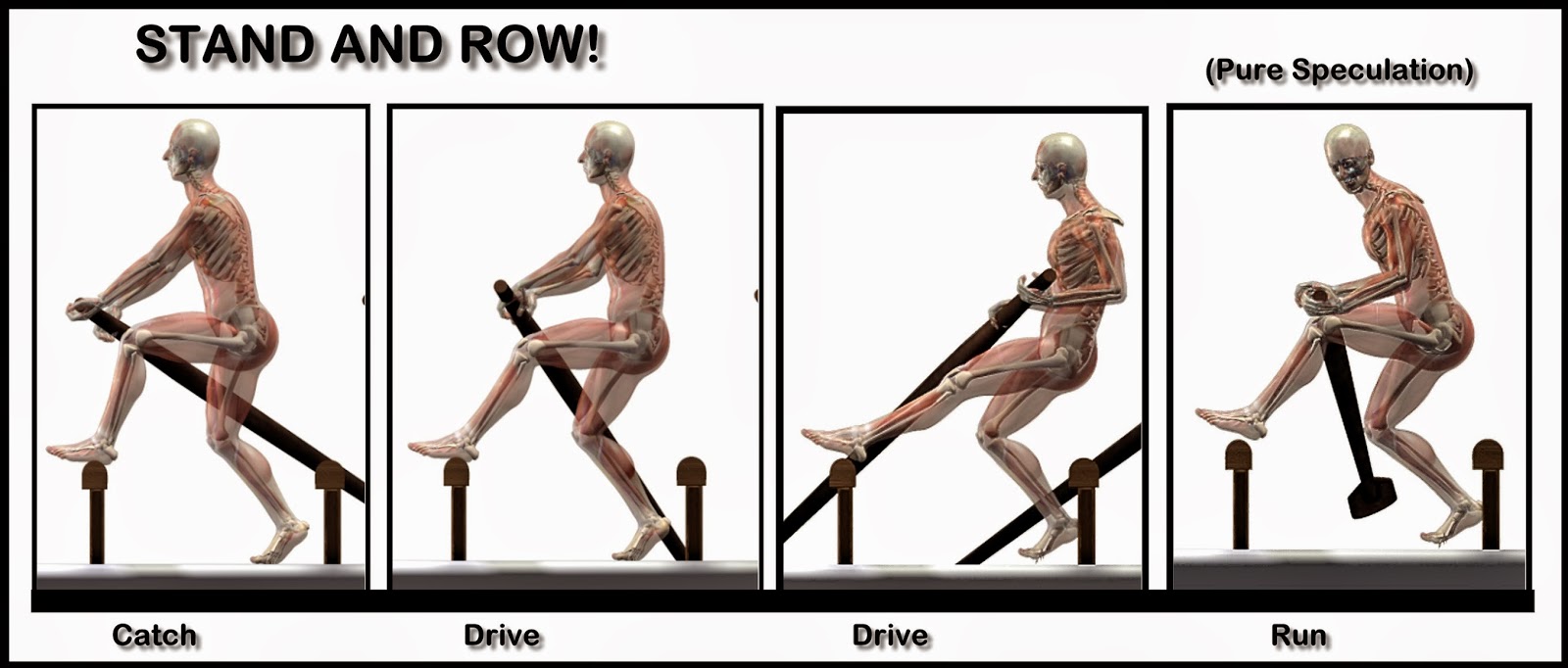
Therein lies the mystery, which is where were the oarsman’s hands, feet and fanny relative to the gunnel, oar, thwart and thole (oarlock).  The purpose of this article is to let in more dark to confuse certainty.  The short answer is that more serious rowing required standing, not sitting.  But more before that:

Oars vs Rudder

If the power of the port (left) is greater than starboard (right), the ship will turn to the right (starboard).  This requires the helmsman to steer to port (left) which throws the ship off balance, by leaning away from the turn;  the ship rocks to the outside of the turn which further unbalances the ship.  Been there, done that.
The selection and placement of oarsmen and their oars with a mix of the skinny, round, tall and short to keep that balance is essential.  While in modern rowing, the person has to fit in the boat, while that choice was not as popular back then.

8

Recovered oars at the same site often differ in length.  Some plans and pictures of the multi-decked ships show the outboard oarsmen with the shorter oar rowing closer to the hull.   More common are the images of two or more banks of oars, regardless of number of oarsmen per oar, having all blades paddle in the same row of puddles.

9

Most oar ships of the day normally had a flat deck from bow to stern, but not always.   Some ships placed the higher benches and longer oars towards the stern.  In order for the oars to synchronize, the bow oars (men) were shorter with the taller and longer, the higher. It also provided a commanding view of the crew for those on high.  That and the guys closest to the boss are tall by mutual assent.

When I was a private (E-2) short in stature I marched in the rear, and as is the effect of short last, the column marched like an accordion with the short on the run.  When I was a Captain commanding an Engineer Company, the tall came last, and the formation got short.   On the galleys of the day, the short came first, albeit backward.

 Gearing Ratio

The relative length and gearing ratio (balance) between handle, thole (oarlock) and blade affects the amount of leverage the oarsman can exert in pulling the boat across the water.  The ratio of oar inside the ship versus outside, defined by the location of the thole (hole, oarlock) as a fulcrum.   In the Medieval Era, that ration ranged between 1:3 (one third inside) and 1:4 (one quarter inside).   1:3 favors getting underway faster, while 1:4 favors speed once underway.


9

Catch and Release

All oars must enter and leave the water exactly the same time and angle cleanly to retain the balance of power.  Splashing slows the boat and the race is won on the run, not the drive.  In short when the oars are out of the water.   Catching occurs when the oar goes into the water, and the release….

10

The oars today are feathered on the run in order to evade snagging the blade on the water (ripples and waves).  This reduces how much the oarsman has to raise the blade/lower the wrists on the run versus lowering the blade/raising the wrist.  This distance must be changed as the seas get rougher.

In modern racing boats, this is all in the wrists.  No kidding.  The blade is turned by rotating the oars forward for the catch and back for the release.  The latter uses the rush of water to flip the oars out of the waters, in lieu of yanking against the water.

11

The historical evidence supporting this use of the wrists to make a clean catch and release is indicated by this old piece of statuary. 


12

The Run


13
The Perfect Stroke (Boston)


14

15


The race is won on the run not the drive.  A sloppy but powerful crew will be beaten by a precise albeit weaker crew.


16
 The essential difference between modern crew rowing and of the good old days is that today the oarsmen (oarswomen) is the modern sliding seat which allows full extension of the legs.  Since the upper body has about a third as much power as the whole body, the big mystery in scholarly studies of rowing has been to ignore that the legs were used in rowing in order to go faster than the other guys. Be they close ahead or astern.

Stand and Row


17
The short answer is that back then they stood and rowed, stepping forward to plant a foot or two against a load bearing member of the ship.  Those include other benches or steps for the purpose. The only time these oarsmen rowed sitting down was in port. This particular example is of a chained oarsman.  At best this shows that standing and rowing was not sitting down.
Later rowing systems based on Italian designs including rowing arrangement of more than one oar to a station, and/or more than one oarsman to an oar.  Crusade Era ships were one and one. 
.


18
These diagrams show illustrate the difference in height relative to rowing stand up or sitting. It is about 3 feet from the deck to the elbows and if sitting.

The basic issue of whether to stand or sit relates to the skeleton and muscular makeup of the body.   The sliding seat likely did not exist, and the amount of stroke an oarsperson sitting down is less than one standing up and moving. Key to this is the difference between seats whether bench or thwart (longitudinally) 

19

 The best ballpark figures I have, show that the distance between thwarts, tholes (oar locks) and oars on Viking ship are about 32 inches (.8 meters) and those on the Galleys were 47 inches (1.2 meters). The oars and tholes in Viking ships were exactly half way between thwarts, with the shield even with the thwart.   


20


21


22
Load Bearing Members Carry the Load of the Members
There is stress wherever the boat, the oar, the water and the oarsman meet and the net result of this stress is a boat in a hurry.  These occur in a sequence from where the foot and the boat, butt and bench, oar and thole, blade and water.  Anything but the strongest materials will cause the boat to stop running.

Leather padding or gaskets reduced the friction of oar on thole.  Some galleys do not have a round thole but a peg or more between which takes up the friction which allowed more than one oar to a thole.   

A standing oarsman on a Viking type ship such as the Knarr could get his weight and body strength stepping on the thwart forward or the smaller one under that thwart.  A galley oarsman normally had a step in front of his bench which was also a load bearing member of the ship.  This is what is shown in the Russian sample.

23

Precision, Decision, and Synchronization.

The subject of oaring boats is huge, with larger variations of equipment and technique.  This treatise shows only show a few combinations.   The drawing in Russian drawing above is one of a ship rowed by slaves (note chain).  The bulk or and primary choice of crews, however, were professional crews of volunteers often chartered by the maritime powers of the world. These ships and oarsmen were often rented out for cash, alliance or privateering.


24


25

Templar light galley- 40 oars, monoreme, crew of 45. Armed with Tension Trebuchet and Greek Fire Projector

Tuesday, July 8, 2014

The Cistercian Connection


Gordon S Fowkes, KCTJ, LTC USA RET
1
Cistercian order was unusual in that it got its hands dirty and acted as a agent of change
The very existence of the First and subsequent Crusades were made possible to a series of revolutions in economic and political life that transformed Northern Europe from backwater and boondock status to a dominance it is retained to this day.  Technology (Tools) drove the process, and it was the entrepreneurial spirt of inventive farmers, craftsmen, and what we call today business.  

The first markets for these inventive farmers were often held in front of the local church, as that was the single most accessible location. The monastery as an economic enterprise provided central direction upon reflection and quickly adopted the technologies to enhance the productivity of the monastery.  The Cistercian Order under Saint Bernard is found in the middle of the process.  What is now called the 12th Century Renaissance is also called the first “world” economy) that went from China to Indonesia to India to the Levant, Europe, and Iceland. Silk at one end, wool at the other. And back again.

 The soil of northern Europe was too dense and damp to be plowed efficiently with the scratch plows of the day to produce much past subsistence.  Even during Roman times the northern woods were at best a buffer or border even in areas under firm Roman control, economic activity was marginal.
2

 In order to cut the heavy soil, the heavy plow was invented which included a cutter (c), plowshare, and wheels and was initially drawn by oxen. The need for speed and horse power as horses pulled two hours longer and faster, lead to the invention of the horse collar which solved the problem of the oxen yoke which choked the horse.  The hooves of horses did not fare well in the damp earth, unlike oxen, which lead to the use of horse shoes. 
3

Oxen could survive largely on hay, but horses needed vegetable protein such as from grain and legumes (beans).  The additional protein in farmers diets lead to increased energy in the people in the area. Yes, bean power.
4

Since legumes contain symbiotic bacteria called Rhizobia were found to restore nitrogen to farmland, crop rotations changed from fallow and wheat to fallow, wheat, and legumes, a change to three crop rotation which also extended the productive use of the land.  Farming is always a gamble, and often a dead end career for those stuck on the farm, particularly when the crops fail.  The woods were often the only place a person could survive, often as bandits.  The woods were also where pigs were allowed to forage for nuts, tubers, and fruits that had been shaken loose by the farmer or game keeper.

 This resulted in a sea change in the land use that allowed the subsistence farmer to go the market originally at the local church to buy and sell.  The creation of markets at the churches gave way to more defined market places that specialized in certain products 

The world of agriculture produced product that was either mobile (sheep, cattle, horses) that required processing (hides, textiles) and resale elsewhere.  Some rooted to the ground that had to be taken to a market for further processing (wines, mines) and some that had several stages of production.  Sheep were a good investment, for their wool, especially fine in the colder northern climates.  Sheep’s wool was sheared by the shepherd, which wool was sold in the Fairs and markets of Champaign, later Belgian for processing and weaving, which was bought by Italians from Northern Italy for further refinement, and from there for international trade
6

The increase in the need for specialized labor and services like blacksmith (Smith) created an entirely system of family names based on trade, craft, or job such as: Spinner, Weaver, Fuller, tailors (Taylor), skinners (Skinner), Farmers, Banker, Driver, Gates, Monk, Priest,  Tucker, Walker, and the like.  The impact of this association of economic function with family name lasts to the present day is an indicator of the dramatic and dynamic change in society, economics, war and politics north of the Alps.

Commerce requires an exchange of goods, services, and/or money.   And the Northern Italians brought their financial, industrial, and transportation skills honed in the Mediterranean to plug into the Campaign, Belgian and English trade centers.  And with the Italian financiers came a necessary connection between the Papacy, and the Holy Roman Empire where St Bernard was a superb diplomat and player in the politics of the Catholic world. 

7


 This was enhanced by the law in many lands that if a peasant, serf or bound servant were able to stay away from the local area for a year, that person was a free person (Freeman) who could work at the growing towns.  The more successful in business and trades created a new social class that lived and worked in a town, called the burger (burg is Germanic for town) hence “bourgeoisie”.  They, then as now, organized into Guilds and associations for the purpose of quality control. 
8


Likewise the tradesmen, artisans, and workers did organize. The first labor laws protecting selected trades were enacted in Ghent in the 11th Century (give or take).  While Burger and the Trades often were at serious odds to each other, when it came time to protect the town, they raised city militias and trained professional quality troops.  All this at the same time as the Crusades.  Machiavelli’s “On War (De Re Militari)” argued that the best military for a Republic was a well-trained militia. 

Politically, there is always a group of “elders” or “good old boys” who serve as either formal or informal form of governance which before 1800 were called, a Commune.  Normally property owners, burgers, and representatives of the guilds and associations, shared power with the titular feudal authority except when they went their own way.  The communes controlled the means of production in their towns and with association with other towns.   The wool producing towns in France, Belgium and Germany were either dominated by the communes or independent as “communal republics”.

Yes, Marx stole the name of a form of governance run by business interests leaving scholars no noun to describe a business oriented polity.   The concept of “capitalism” likewise make it impossible to mix business and politics except behind the door. 
9

Many Italian city states used the communal republic as a form of governance. As such, Florence, Genoa and Venice were republic in form.   Universal suffrage was a 20th Century development.  Romeo and Juliet is about a family feud within the Republic of Venice.   These Italian cities provided the banking, trading and maritime skills for the wool producing regions which regions later shifted to Belgium and England. 

 We know that St Bernard of Clairvaux whose monastery was near the wool market at Bar-sur-Aube orchestrated the recognition of the Knights Templar at the Council of Troyes in 1129, a decade after their founding in Jerusalem.  Troyes was one of the cities that held the annual Champagne trade fairs which brought to the fore, the domination of the early wool trade.   Trade in textiles before the US Civil War had the same influence as does oil does today.  King Cotton did not save the CSA.

St Bernard was a cut above your average run of the mill king maker, he was the Pope maker (three or four) behind the door as well as up front in the pulpit.  King makers came to him.   As the Papacy’s premier and extraordinary representative, he was a Guelph (Papacy) versus Ghibelline (Holy Roman Emperor) in their struggle to control the wealthy north Italian cities. These cities had organized into alliances such as the Lombard League in league with the Frangipani (three popes and thirty four cardinals) and Orsini families. 
10

This further allied the powers that were in France and the Low Countries in also in opposition to the Holy Roman Empire.  Key amongst the French supporters of the Papacy included Counts of Anjou (Fulk or Foulques) family who were avid supporters of the Cistercians, St Bernard and the Knights Templar. Fulk III had built abbeys and monasteries in the Loire valley (heart of France).  Fulk IV became King of Jerusalem, and his son, Geoffrey Plantagenet was the first of the line of the Plantagenet Royal family of England (as in Richard the Lion Hearted) and of the Angevin Empire.

 Go figure

NNDNN