Monday, April 14, 2014

The Tips of the Spears


Sergeant Jason, above, is about to deliver a telling stab to those uncovered target is in range and ranged.  His spear is held in position to stab down and in front with the point of the spear on the little finger side in what may be called the “over hand” grip.  The Bayeux Tapestry show the over hand grip as default in the shield wall to facilitate stabbing down and out over the wall of shields.

Overhand grip used by both sides, infantry and cavalry
Sp-1
The “over hand” grip with the arm back as if in throwing (rock, spear, and javelin) is also used with other weapons such as the sword, axe, and/or club.   The advantage of the overhand pose, regardless of the weapons includes a better twist on the base of stirrup and hip to the upper body, and a greater range of upper body movement that would otherwise been hampered by being knee to knee, stirrup to flank of the horse on one side and the chest of the horse on the other side.
Mongols here also show the overhand grip
Sp-3
Contemporary art of the century after Hastings (1066-1166) reflects the shift in Western mounted warfare towards the couched grip.  Indeed, the Tapestry features three grips, couched, low grip and over hand
Regardless of East or West, mounted or on foot, the over hand option used with the spear or lance requires a 180 turnaround of the butt of the spear for the point.  This requires a certain amount of dexterity which may have supported the choice of couched lance as it is easier. 

Sp-4
The grip on the shield is as depicted in some of those on the Tapestry with only one rope or leather strap close to the top of the shield. In the Tapestry shown above the shields held this way for the cavalry rotate with the wind and appear to by flapping in the breeze.   
Broom and mop handle verified
Sp-4
 This is a matter of wrapping the fingers under the spear, and using the thumb to push the spear around at the same time as raising the right hand. This minimizes and undue spear spinning which could be lethal, and ruin some buddy’s whole day.
The knack of doing this right depends upon a lot of practice, particularly while being jostled around.  The infantry has to do the rotation in close quarters about the second rank from the front. 
There may be other ways to do this, and it is something to look for in original sources.  As a matter of course, I find art not of the period reflects what was current at the time the art was rendered.  Those in more modern times like the 1800’s are limited by the lack of direct evidence or original sources.
Aquí termina la lección


Tuesday, March 25, 2014

Crusade Era Combat & Murphy's Laws


I love the TV Series, “the Vikings” and a fan of all manner of blades, spears, arrows, shields, helmets and horses in battle and duels of a more personal face to face era of closed order close combat.  Whether by Hollywood’s need for close in action or by virtue of a lack of experience to recreate close order of battle, Hollywood Combat wouldn’t last long back then, for a lack of knowledge of “ergonomic combat” i.e. a fit between weapon and body versus the other guy’s fit.   In other words, one could get killed wielding weaponry like in the flicks. 

This is a proper shield wall from the Bayeux Tapestry of the Invasion of England in 1066.  Shields were held in a “Norman Grip” to the left shoulder leaving both eyes to focus on the enemy. Overlapping shields were a wall over which battle was joined.  Spears held in a stabbing grip to stab over the shields.  The shield wall was developed by the Vikings and remained the European default until Pike and Shot made the shield obsolete by 1400. 

This is not any variant of a Shield Wall, Viking or not.  One does not kneel before thine enemies!


Or attack with wide gaps to meet a real shield wall.

003

Close combat, as in the combatants were at arm’s length or a few short steps away preceded the first rock and will continue until after the last.  Close order combat came to an abrupt end in the First World War when it was no longer practical to be too close to your buddy or be swept away in the next full burst of machine gun fire, or exploding shell.  Those that didn’t get far enough apart, not less than five yards, were seriously killed or wounded. Back in the days of close order combat, more than an elbow’s distance left gaps too big to cover. 

The Hollywood/Re-enactor paradigm on wielding shields (with spear, axe and/or sword) is contrary to the Bayeux Tapestry shown above.  Those mounted and dismounted on both sides, hold the shield with what looks like an arm wrestle grip to the shoulder.  Those on the ground in the shield walls overlapped their shields and stab down over the wall of shields.  This requires a left foot forward, with the right arm stabbing at an angle like chopping wood.  And most importantly during the final delivery of the blow, is to have the eyes on the “inside” (between the hands), and not with both hands on one side or the other.  With two handed weapons, the eyes must look directly over the grip and at the target as in “keep your eye on the ball”. 


004


But nothing is as neat as we would like them to be, hence:
ANYTHING THAT CAN GO WRONG, WILL GO WRONG -
 At the worst time and place.
The Startle Response, Murphy’s Revenge
Close Order battle requires strong cohesion as adhesion between those in front, flank and rear.  If that adhesion weakens, the enemy will attack to broaden the breach and pile on.  Once this happens, any one person who panics often triggers a startle response in which the feet move first and the rest of the formation scatters the formation like popcorn in a high wind.   This is true in panics in public as in burning restaurants, theaters, and in outside crowds on a startle response.

Consequently the decision to go to battle was carefully considered, given Murphy’s Law, and the chances of an adverse startle response.  The planning for battle was largely based on creating a startle response in the enemy force.  Once more, into the breach!

006


The Startle Response (Panic) can be replicated in training, as one of my Commanders did when I was a squad leader.  The company was deployed on the military crest of a low hill, when it was attacked by the First Sergeant yelling like fury.  One soldier leaped to his feet, tossed his rifle and fled, and the one next to him followed suit. The company scattered like popcorn in a high wind.  The gimmick: the one who yelled was in on it, the guy next was told to follow suit, and a hundred others fled.  After recovery, the CO taught us what panic feels like, what to do and what not to do. I have repeated this drill over the next twenty five years for the same reasons, and the same effect.

A “Tipping Point” is different from a “Startle Response” although the results may look the same. A Tipping Point is the result of a process of increasing pressure, while the Startle Response can occur in an instance regardless of how well the rest of the formation is doing.  

007


 Pickett’s Charge at Gettysburg was like a Tipping Point where deadly fires from Union rifle and gunfire progressively reduced Confederate offensive power to the Tipping Point led to a withdrawal under fire.  The Startle Response can be attributed to Stonewall Jackson’s flank attack (in a mile across wall of infantry) at the Battle of Chancellorsville (May 2, 1863) on the far right flank of Hooker’s Army after marching across the “nose” of the Union penetration south of the Rappahannock River.   One is a build-up, the other is a surprise, although a Tip leads to Panic.

The Biology of Panic

The Biology of Panic follows two paths in the brain to the switchboard of the Amygdala, Smell and Audio-Visual, which produces chemical changes to make things happen or not.  Training can reroute the stimulus to learned responses without the intervening inconvenience of thinking about it.  Using a multi-sensory battle simulation works best when Smell (olfactory) is added to Audio-Visual.  Smell is the oldest of senses and is routed through the Thalamus to activate the Limbic System while Audio-Visual is routed through the Hypothalamus which goes to the Cortex both by way of the Amygdala.  Smell (Stink) produces action without reflection.  So, in order for training to Stick, It Must Stink, however slight.
008


Fear Stinks and unsticks the cohesion of a startled or tipped unit.  We know that animals can sense fear, and in Vietnam, US soap on US GI’s could be smelled by the VC, likewise so could “Nguc Mam” (a fermented fish sauce) by the GI.  The effect of female pheromones on the human male is not identifiable as a smell, but reacts predictably, so is the reverse effect of the sweaty male on females. 

The nose knows.

Thunder and Lightning (Audio Visual)

As sudden Audio-Visual effect such as a bolt of lightning, or incoming round can be routed by the Amygdala to activate autonomic responses (panic).  I have seen this work in opposite directions while stationed at Ft Huachuca at the Intelligence School as an Imagery Interpreter. 

The Sonic Boom. I had been back from Vietnam about two years, the rest of my starting class had been back less than that. Ft Huachuca is next to the Mexican border where the FB-111 fighter-bomber was allowed to go supersonic. The double bang of the supersonic shock wave sounds just like incoming rounds.  Bang-bang and half the class was on the floor before the second bang.  The other case was no reaction at all when an ammo train blew up by I-10 near Benson, AZ.
009


Look and Listen before action even automatically, or immediately after. Once fear is on the wind, defense is provided by monitoring and comparing the sense of fear versus what can be seen and heard, objectively.  Such was the case of Crusader Shield Walls defending against charging cavalry which audio-visually is terrifying, but once trained the mind can set aside the sense of fear and focus on tactics, techniques and procedures.  That is also what the psychological effects of shock effect of tanks is

The Relaxation Response, Qiqong, and the Berserker

Another defense against the dark side of panic is to ignore it, bypass it, and let the body to the fighting leaving the mind for casual strategic analysis.   It has many names, but all depend upon controlling breathing from short and upper to long breaths and lower.  We do this every day during commuting time by whatever conveyance is at hand.  One does not get into a conscious rational internal debate over what angle and direction the steering wheel, gas pedal and the inter-vehicular spacing should be except when a strategic decision is required.  When one does get excited, the effective control of the vehicle takes more energy than just cruising.   Consequently when excitement tends to take over the automatic learned responses, the remedy is to calm down, and that is called “taking a deep breath”. 

010


In combat’s sharp edge, regardless of boot, track or hoof mounted, under stress, the internal stabilization mechanism narrows the field of view, shortens the breath denying the brain of oxygen, tightens up muscle responses and focuses the active part of the brain on specifics and not the strategic bigger picture.  And when hit, it hurts more than in relaxed mode. The trick is deep breathing, visualizing and shutting down the mind chatter. 

This is called “Zazen breathing” also called “Mushin”, (no mind) in Japanese Martial Arts derived from Indian and Chinese models.  It is also called the Relaxation Response in Bio-feedback, the Zone in athletics, the Lozanoff technique for learning foreign languages at UH Houston, Qiqong in Chinese Medicine and martial arts, but does not affect physical items like “The Force” in Star Wars”

The Viking Berserker is said to have gone into a state of madness, when such would have prevented him from effective fighting.  The state of relaxation of the mind, and quieting mental chatter, allowed the Berserker to fully maximize his physical strength, minimize tension, and let the trained body to do the fighting while remaining in a quiet state of mind.   The true martial artist calms down in order to fight, instead of the hopped up state so dramatic in storytelling. Bruce Lee did no one any favors by his scowling noisy self while Steven Segal, an Aikido Grandmaster, stays calm while demonstrating.

A trained knight or warrior stays alive on these principles, or dies without them.

Body, Armor and Acupressure

As it is in medical advances down through the ages, war brings out the greatest advances.  Chinese Traditional Medicine (TCM) was learned from battle savvy warriors who had learned that hitting, rubbing or pushing on certain parts of the body had some singular advantages.  This included disabling and joint, producing weakness and knock outs.  In traditional Professional Street fighting in urban financial protections and entertainment industries, debt collection was facilitated by a “clip to the back of the jaw” or in the Ring a knock out could be produced with a cross to the jaw. 
The West did not learn of the meridians, the yin-yang dichotomy, and the five elements until after the Korean War and by virtue of immigrating Orientals and returning US troops lead by Grandmaster George Dillman, 9th Degree Black Belt Ryukyo Kempo (Okinawa).


On the other hand, neither did the West start to learn about the nervous and circulatory system until Da Vinci’s ideas began to sink in.   While there was considerable interchange of knowledge between East, Middle East and West during the Crusade Era, but a premature exposition of said knowledge was often treated with an Auto-da-fe or axe.  That may have been a contributing factor in the machinations leading to the Burning.

011


In broad terms, the illustrations with the colored lines and dots are replication of the locations of the Meridians color coded by their respective “element” as used in the Cycle of Destruction (FIRE burns METAL cuts WOOD penetrates the EARTJ dams WATER puts out FIRE).  The location of the Points on the Meridians is normally where a nerve comes to an end, crosses or forks.

In order to work the pressure points must be in the order, angle and sequences and may involve a push, a hit, or a rub depending on the specific sequences.   The angle and directions required are contained in the prescribed forms, or kata used by any of the Oriental Martial Arts. In the Medieval images I have found one or two points being used to facilitate the collapse of an opponent’s ability to fight.
012


This is the chart I used from Grandmaster George Dillman, the first 9th Degree Black Belt to be made privy to that which had been kept secret by the Okinawan masters of connection of the Martial Arts to Chinese Medicine. It has many names such as Pressure Point Fighting, Tuite, and Torite.  While the Medieval soldier did not know of the system in any form, the images and training manuals from later medieval times clearly show they knew how to use some of them.
013


The student of the fighting arts or styles of any kind or time, can understand what the reasons for some moves that did not make sense in the sense of smash, grab, break, punch or kick went places not worth the treatment.

Defensive Armor and Acupoints.

Likewise in the history of combat down through the ages, armor protection has been developed specifically if not consciously to protect against the most sensitive of pressure points. These include greaves, gloves, arm guard, and helmets.

014


The Body Knows.

The dome of the skull is normally the first order of protection, and that today includes any sort of hat. Then any protection that protects the forearm, and shin (by extension the hand and foot) against any hit, push, or rub that releases the joints or confuses the head (eyes, ears, and brain).

015 


Melee Not
The ever so popular melee on screen increases the “Murphy Factor” and the results become unpredictable.  The sight of one person moving away from the battlefield can trigger the panic by virtue of tipping or startle which are the handmaidens of Murphy’s Law.   A major percentage of the time spent by opposing forces was in shouting matches and combats between champions.   Such was the case at the battle of Yarmouk between the Eastern Roman Empire and the Rashidun Caliphate in 15-20 August 636 southeast of the Sea of Galilei.  The battle is considered on the short list of decisive battles as it ended Roman (Christian) dominance of the Levant until the Crusades.  There were several days of taunting and champion combat until the cohesion of the Roman formation left too many gaps and not enough maneuver room.
016


Military planning and leadership on the battlefield, then and now, is to defeat Murphy’s Laws with forces in reserve, contingency planning, redundant communications and the whole of military science and art.  The timing of the commitment of a reserve is critical, too early gives the initiative to the enemy, too late the initiative stays with the enemy. 

Training, training, good doctrine, equipment and leadership2 if not focused on actions in confused situations absent information, and misguided instructions, is an open invitation to Murphy’s Laws.

Hometown Battle Drill

Defense against Murphy usually is encoded into the local customs of combat which often were highly specialized as archers (Welsh Longbow), crossbow (Genoa), light cavalry (Poland and the Balkans), pike (Swiss), two handed axe (Varangian-Swedes) and the Shield Wall (from the Vikings to the Crusaders).  In today’s parlance we use the terms doctrine, SOP, principles, procedures, and the current US Army TTP (tactics. Techniques, and procedures).  In order to fight effectively including sophisticated maneuvers such as a passage of lines clearly indicates a common “understanding” that functioned like modern doctrine.

In Medieval times, change came slower as local customs, values, beliefs, behaviors and norms were embedded in the body of the local society. What produced superb warriors in one century produced targets in another.  The knowledge was passed down in oral and in child raising and was impervious to change until literacy interfered.  Then the pace of change can occur in hours where centuries were required in the past. The legendary unit cohesion of US National Guard units is tied to community and traditions of long standing.
017


Included in the “doctrine” according the custom, were the formations, command, and signal such as by rank, file, and signals (pennon, flag, distinctive uniform appendages, music) and leadership from the front). 

Medieval Doctrine?

A common understanding (similar to doctrine, and TTP) existed in medieval combined arms and joint forces, logistics and deployment for combat is evident in medieval combat, particularly in the better trained units.  Yet these are not written down anywhere, nor do many remember what was done, as the latest thing blows the old away.   That these existed is evidenced by the sophistication of the march under Richard the Lion Hearted from Acre to Jaffa including the victory at Arsuf on September 7, 1191 AD. 
 
Ordinarily Shield Walls did not move, yet in the march from Acre to Arsuf, the shield walls shuffled along absorbing swarms of the rapid firing low velocity arrows of Saracen and Nubian forces under Saladin.  This protected the horses of the heavy cavalry from arrows, which now protruded from the infantry’s protective armor and padding.  When the Knights of the Hospital attacked the tormenting Ayyubid archers, Richard called for the Cavalry to charge, but to do so, had to do what is called today is a “passage” of lines and is considered the most difficult maneuver in modern times, especially when there is a passage from the enemy side.   

The Crusade Era infantry could do both.

Finem de Léctio


Sunday, October 27, 2013

Greek Battle on Mount Tamaulipas

This is also a riddle. Where do the warriors com from


October 27, 2013
The Greek Hoplite and Phalanx

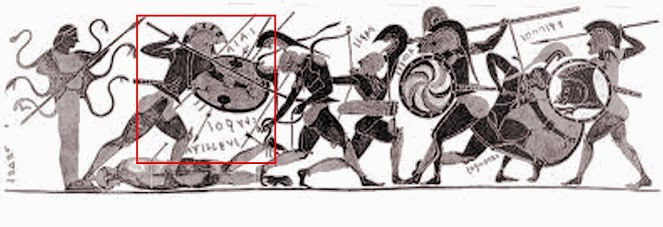
The shield wall developed in the West from Viking beginnings had counter parts in earlier times, that of the Roman Legion and the Greek Phalanx.   Depicted above are two Greeks at the Battle of Mount Tamaulipas.  The Greek Phalanx was superseded by the Macedonian Phalanx featuring a long pike and losing the Hoplon (round shield above).   The highly flexible Roman Legion were equipped with a spear that could be thrown or held, and square shield curved outward plus helmet and body armor.


The Greek Hoplite carried a heavy convex round shield called the Hoplon, a spear, a Corinthian helmet , greaves for the shin and bracers for the forearms.   And that was all they wore in the earlier days, later they added a breast plate and protection for the shoulders and thighs.  The images in this issue of Templar Militaris a loin cloth was added for the demure.


In these images of one particular moment in time where both warriors are a half step from effective stabbing distance.   Each has the same equipment and the poses are the same except for where the spears are aimed, eyes ball and the other balls.   The grip on the shield is extended down and toward the threat with the arms held straight which we might call the Straight Greek Grip.   This grip also allows the warrior to adapt a Clench or Strong Grip found in the Shield Wall of the Time of the Temple.


Note the red square which shows the straight Greek grip on the shield

 
Camera placed directly under duel and shows the straight arm grip by both warriors
 
Image labeled as Iliad shows both warriors with Greek straight arm grip 
 
There is a long and tough relationship between the two communities


The crouch kills any chance of movement forward or back, and the couched spear has no power from the seated position

In this case the Persian has both hands on one side of his eyeline (nose) which weakens both arms and balance.  :Leonidas is carrying his spear too low for full torque and his shield would do better in the straight or clenched grip. If so the Persian would go alpha over teakettle on collision.

From a wooden frieze showing the warrior on the left using his leverage to push the other's shield to cross the other's hands on the same side of the eyeline

The historical record of original drawings and art of the time shows the “Greek” grip even into Roman Times


To follow:  The Medieval Hand at War
Bear Fight by Gordon S Fowkes.


Sunday, October 6, 2013

THE TEMPLE AND THE TACTICAL IMPERATIVE


The Temple and the Tactical Imperative.
The Shield Wall was an infantry formation unique to Western Medieval forces of the Crusade Era and to the Roman Republican and Imperial infantry.   The shields of the Shield Wall were heavy and large to protect the spearman and the gap between another whose offensive firepower was delivered over the shield.  The primary grip was close to the top and horizontally so that the weight of the shield was carried by the left shoulder by the left arm in a tight “Strong Arm” grip.
 Absorb.  The tactical imperative used in by the defense against the Fist (warhead, blade, blunt end) is to absorb the shock or dissipate it. This also applies to castle walls and fox holes.

The “Strong Arm” grip held close to the shoulder also is reflected on the placement of grips on the shields themselves.  At least one horizontal grip or handle is placed close to the upper edge of the shield and sometimes another horizontal handle across the forearm nearer to the center of the shield depending on size.


The Shield Wall as the name states is a wall that doesn’t or shouldn’t move.   This would risk a gap in the front ranks which is a very bad thing to happen to the infantry.  Once the overlapping shields expose the fighters behind, they become vulnerable.    The English (Anglo-Saxon) shield wall stood on Senlac Hill for twelve hours before the wall was cracked by a Saxon contingent that thought it was Plunder Time and went after some Normans moving to reorganize, reform, and return.  Some say this was a feint, and perhaps it was.


The Bayeux Tapestry shows what happened after


This sort of indiscipline was the death knell of many a battle for whom lost their cohesion. One of the distinguishing tactics of the descendants of the steppe way of war was the bait and switch by fast and flexible forces, usually mounted archers of which more will be told in a following edition.  The bait and switch tempted Crusader knights to do their specialty, the Charge with Couched Lance,  The light horse would evade and withdraw until the Knights cohesion was lost, horses blown, and a gap between them and their infantry. 


The Battle of Liegnitz in 1241 as depicted in the war game link above (8:11 with music) illustrates how the Mongols destroyed a Western Army resulting in the conquest of most of what was Russian at the time. It was not until Ivan the Terrible was the damage undone.


The Tactical Imperatives of that battle give show the Mongols had the right stuff, at the right place and time.  The only Imperatives the West had was the resilience and armor of the mounted knight to parry and absorb Mongol hits.  Over the centuries that followed, the Russians and Poles developed light and middle weight cavalry to be able to evade and return to worry the cohesion of opponents East and West. 

See also maps at of Battle of Mohai Heath:      BATTLE OF MOHI HEATH 1241


To redress imbalances between the heavy mounted knight with power and speed, but not much flexibility and the heavy armored infantry with the ability to absorb but not the speed to evade or duck has been addressed continually down through the ages.   In the Crusade Era, this meant fast and light both mounted and on foot.  These forces were usually have weapons with some range and/or speed. 

In the Battle of Liegnitz, mounted crossbowmen were used to add the speed of the horse with effective long range firepower.  Crossbowmen, mounted or not suffer from a slow rate of fire.  Eastern forces used mounted long range bowmen on horseback, but they dismounted to fire as was the case with the US Cavalry in the Old West and with Mechanized Infantry before the Bradley.  The default Steppe warrior and descendants used a short range rapid light arrow or bolt from horseback. They could evade Western spears and arrows to pour enough arrows to confuse and trip.


The Battle of Crecy between England and France over who was who in 1346 shortly after the Crusade Era in the Levant shows the trade offs between crossbow and longbow.   The French were so eager to smash the English that they deployed the Genoese crossbowmen before their wagons with their big shields, the ground mounted pavise behind which archers and crossbowmen conducted business.

Caught in the open by English Archers in range and with a very high rate of fire, decimated the Genoese. They started to back up, but the flower of French chivalry rode them down, and into the mud the knights did ride.

Light Infantry Screening Force (Flank, Front, Rear and Gap)

The Bayeux Tapestry shows infantry being used in ways not often recognized, that of flank and “gap” screening missions.  Traditional doctrine and practice recognizes Reconnaissance and Security as two forms to address larger or more dangerous forces.   There are differences in the mission. 

Security Forces orient on the force being protected, while reconnaissance orients on the enemy force.  Two security force missions are the norm, the blocking force and the screening force.  The difference is firepower. Both try to force the enemy to deploy for battle early and slow them down. Normally, these forces are entitled by Front. Flank, or Rear screening or blocking forces.  There are also gaps to be screened and/or protected that are not commonly labeled as such. I use the term “Gap” to describe the Guard or Screening mission (Gap Screen or Gap Guard).   

Screening forces were used by the Normans at Hastings as depicted on the Bayeux Tapestry as archers running along between two groups of Knights on horseback.  Archers and light infantry with small round shield held with a center grip are seen as very small in the margins of the Tapestry.


The Tactical Imperatives leveraged in Security Missions include holding initiative pertaining to the eyes and the brain, while being able to force the other side to slow down, get cautious, but unable to stand and fight for long 

The Medieval 2 Total War (HASTINGS IT IS NOT)rendition show a vigorous but completely erroneous rendition of the arms, equipment, tactics and techniques. The game shows both sides with round shields held with Center Grip, whereas both sides in the Tapestry have the kite shield and use the Strong Arm Grip.   Both sides are shown the sword as the primary line infantry weapon but held in a “couched” position (adopted decades after the battle). The net result as shown in the game (closer look) some spears are protruding through the shields.  This was an error I made in cross checking what worked.


The same rules and roles of combat in the Crusade Era apply to all of the after.  That which shifts with technology, mission, enemy, terrain and the cultures involved, are the Tactical Imperative. 

THE TACTICAL MILIEU OF THE CRUSADE ERA

The Archer: Tactical Imperatives become active when at least one side gets “in range” the other with at least one weapons system.  “Range” and “Speed” are the two sides of the sandwich. The Tactical Milieu is the mix of Imperatives.   In the Crusade Era that meant the fast moving light cavalry or light footed infantry plus the ranges of their weapons against any enemy force that is out of range of those who are. Crusade Era maximum ranges of weaponry were in hundreds of yards and the distance cavalry could close. 

In close battle, which differs from close order battle because the enemy is close.  The most effective ranges were less than arm’s length plus the range of the weapon.  That put the spear ahead of the sword, and the javelin and thrown axe ahead of either.  But it is the Archer that opens the tactical imperatives for the dismounted. They are usually first to close the range with the enemy deadly enough to stop walking and to get ready to fight.

No one has found written records (firing tables) for medieval archery, yet the revival of the bow for hunting and sport does provide comparable data, giving modern steel versus bone and wood. Firing tables or comparisons of the maximum effective range of a rifle versus a bow and arrow on point targets are interesting stories, but in close order battle is against a crowded foe that covers a football pitch at  shoulder to shoulder distance apart.  Engagement by bow, arrow, crossbow and bolt were against area type targets much in the same way machineguns are deployed.

Thus the use of the machine gun against area targets applies as well to other rapid firing ranged weapons with regard to the ground and the enemy.


The definition of “maximum range” depends on the shape and size of the target.  Archery is closer to firing a machine-gun which has a “beaten zone” in which is defined in part by the Circular Area of Probability (CEP), the shape and size of the target, and the azimuth laterally and in depth from the firing position.     The optimum target for a machine gun is enfiladed, the long axis of the target is the same as the gun-target line.  Since the machine-gun is a rapid fire weapon, the beaten zone is moved left and right to cover targets of width.  As did the Archer.


The archery equivalent of a beaten zone has been tested in what have been called “Flight Archery” in which the range of the arrows counted more than the targets.   The Turks had the reputation as the best in this category with ranges up to 800 yards.  Considering the most common targets in the Crusade Era were massed targets engaged with massed archers which suggests an effective range out to 300-400 yards/meters depending on the bow and the armor on the targets


There has been a long standing argument about the performance of the longbow versus the crossbow.  The biggest difference is that the crossbow can be combat effective with a couple of weeks training, the long bow takes years.  The Crossbow shoots in a flatter trajectory at a higher velocity, with a point blank rage of 70 yards, and angled up to 45 degrees can reach 350 yards.A Crossbow is extremely slow to reload compared to any bow.  


MOUNTED ARCHERY

Mounted Archery suffered from reduced accuracy and range which was acceptable depending on the speed of the mount.   This trade off between speed, armor, and firepower is at the heart of modern tanks design and equally applicable to Medieval times for both mounted and dismounted soldiery.  The M1 US Tank was the first to use gun stabilization so as to fire on the move.  The British and Russians of my day in the hatch preferred the move and shoot. While the Germans and the US was stop and shoot. The US Cavalry in the Old West could charge with pistol and sword or dismount to fire with their carbines or rifles.  The choice was largely dictated by the ground, relative speed, and armaments.  So Archers and Crossbow were often mounted but dismounted to fire on the militaries of this era.

The typical Turkish and Asian mode was to shoot on the move at a higher rate but with a lower range and penetration.


The Mongols, Turks, and their predecessors, the Scythians of the Steppes had the control of who moved at whose initiative.   With the exception of enemies able to block the movement of Steppe horses, by fortification, shield and/or spear wall, or obstacles natural or man made.

Japanese Yabusame mounted archery competition in Japan calls for precision shots at three targets ten meters away at the gallop over a 225 meter course.   The Steppe tradition included close range distances with a lot of arrows at the gallop. Some fired more than one small arrow at the same time.   This was the sort of archery faced by Templar forces, particularly noted in the Battle of Arsuf.


The Steppe and Asian archer uses a distinctly different way of handling the bow and the arrow.  The Asian fires his arrow on the thumb side (right) of the bow and uses a thumb grip on the arrow. The Western archer fires on the finger side (left) using three fingers to steady the arrow and pull the bowstring to the rear.  IMHO, the reason for the thumb side Asian draw is to facilitate shooting to the left without jabbing the horse in the neck with the bow lilted clockwise. 
   
Other tactical differences of strategic and operational significance. 

The Western armies of the Crusade era differed in a small number of competing arrays.  The Western knight’s charge with couched lance was formidable and not equaled in the East.  There were heavily armored forces in Islam and East, including lamellar armor for the horse.  Unlike the West their lances were carried much like a quarterback in American Football just before the pass. This method is the predominant one in the Bayeux Tapestry.


One comparative advantage to Muslim and Byzantine forces of a wide array of light forces which normally do not close with the main Crusader defensive Shield Walls, but a series of pin pricks to the point that one report in the running battle of Arsuf of the effectiveness of Western forces said that some Crusader infantrymen had up to ten arrows stuck in the mail and padding and continued to march. 

Link to Youtube with Total War rendition of the battle (9.05)  BATTLE OF ARSUF (Click here)
At the running battle of the Third Crusade between Richard I and Saladin between Acre and the port of Jaffa which was the optimum location for logistics support of operations in and around Jerusalem. The heavy infantry of a slowly moving shield wall (which is unusual for walls) that protected the horses from the rain of arrows from fast moving light archers.  The tactical intent of Saladin was to invite the Crusaders to make a charge that he could evade and duck until the steam ran out of the horses, then to charge with his own heavy cavalry to run down a weakened shield wall.

It didn't work out that well, when the Hospital had had enough of slings and arrows, and ordered a charge, as the Shield Wall parted (passage of lines). King Richard knew that this was the time to put all down, and ordered the other orders, Temple as well, and chased Saladin out of town.
There are two questions before the next piece in released:

1.        How do the spear man reverse the spear from thumb side to pinky side towards the steel when in the front line?

2.       How does an archer run and shoot when enemy is in front?  Twist and shoot?

NNDNN